
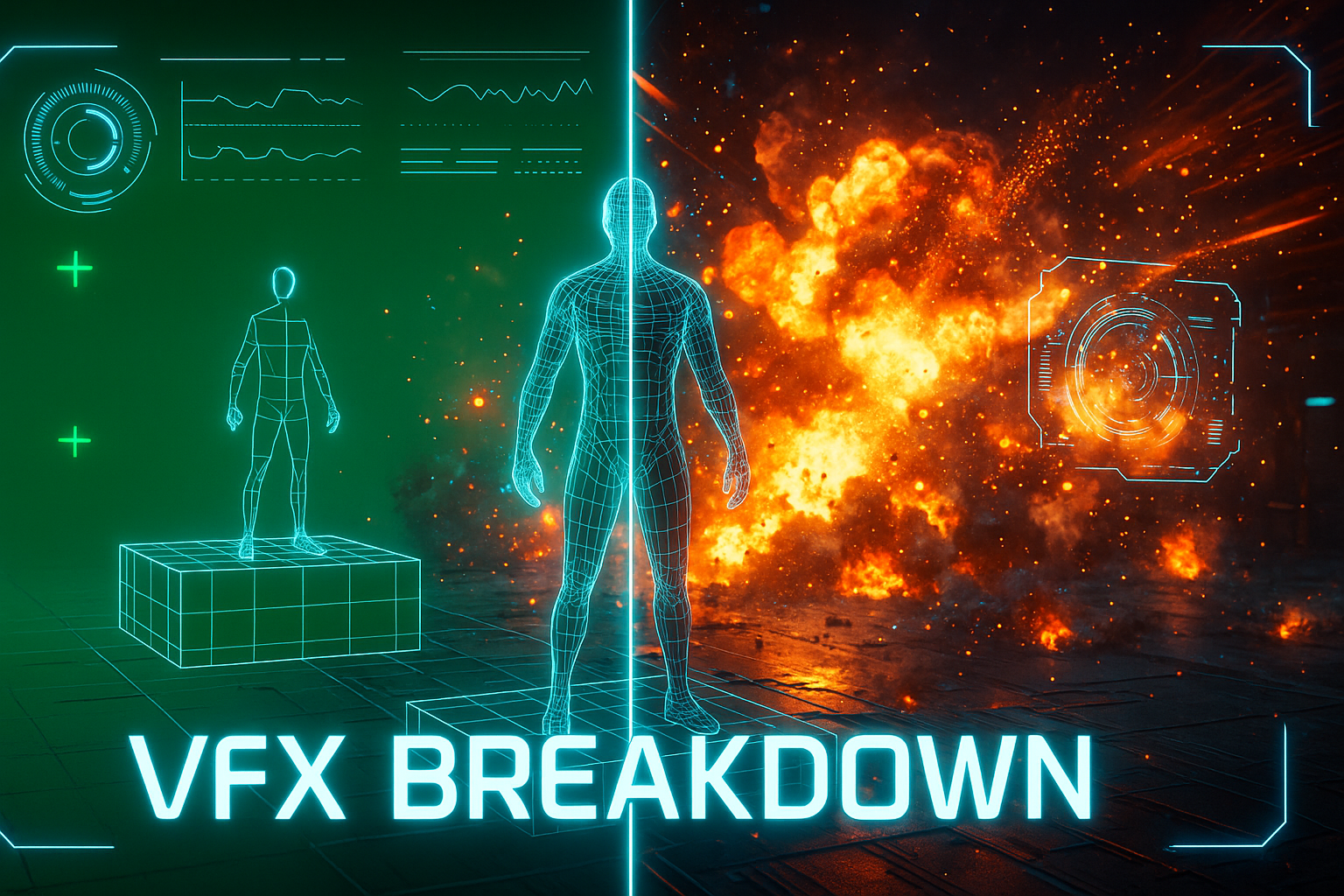
VFX Breakdown Explained – How Modern Visual Effects Are Created
Visual Effects (VFX) have become one of the most important elements in filmmaking today. From superhero battles and explosions to fantasy worlds, creatures, and futuristic environments, VFX helps filmmakers show the impossible. A VFX breakdown reveals how these magical scenes are created step by step, combining real footage with digital artistry. In this guide, we explore how VFX works, the stages involved, and why it plays a vital role in movies, TV, games, and even advertisements.
1. What is VFX?
VFX, or Visual Effects, refers to the process of creating or manipulating imagery that cannot be achieved during live-action filming. It enhances storytelling, makes action scenes safer, and allows directors to visualise ideas beyond physical limitations. VFX includes CGI (Computer Generated Imagery), green screen compositing, matte paintings, digital doubles, particle effects, and more.
2. The Importance of VFX in Filmmaking
Modern films rely heavily on VFX for several reasons. Action-heavy movies use digital explosions and environments to ensure safety. Sci-fi and fantasy films create creatures, robots, and planets that cannot be built physically. Even simple romantic dramas use invisible VFX to remove unwanted objects, enhance lighting, or improve background visuals. VFX is no longer just for big-budget films; even low-budget productions use it for subtle enhancements.
3. The Complete VFX Pipeline
The VFX pipeline is a step-by-step process that takes raw footage and turns it into a polished final sequence. Here’s a breakdown of each stage.
3.1 Pre-Production
Before shooting begins, VFX artists plan how scenes will be created. This stage includes:
- Storyboarding: Creating sketches to outline the scenes and shots.
- Concept Art: Visualising characters, environments, and effects.
- Previsualization (Previs): Making rough 3D animations to plan camera angles and timing.
- Technical Planning: Deciding what needs green screens, CGI, or practical effects.
3.2 Production (On-Set Filming)
During filming, special techniques are used to ensure VFX integrates smoothly later:
- Green/Blue Screen: Actors perform in front of colored screens for later compositing.
- Tracking Markers: Dots placed so software can track motion for CGI.
- Motion Capture: Actors wear suits to capture movements for CGI characters.
- Plate Shooting: Clean shots of the environment without actors for layering.
3.3 Post-Production (VFX Creation)
This stage contains the bulk of the VFX work.
• 3D Modeling
Artists create digital models of characters, vehicles, creatures, props, and environments. These models act as the “skeleton” for CGI objects.
• Texturing
Textures give models skin, metal, cloth, or surface details. Without texturing, models look plain and lifeless.
• Rigging
Rigging adds a digital skeleton so models can move. It is essential for characters, animals, and anything that animates.
• Animation
Animators bring models to life—making creatures run, robots fight, or dragons fly. Every movement is planned carefully to look realistic.
• Simulation
Simulations include realistic details like:
- Hair and cloth movement
- Fire, smoke, and explosions
- Water and sand behavior
- Destruction of buildings
• Lighting
Lighting makes CGI blend with real footage. Artists study on-set lighting to match shadows, reflections, and highlights.
• Rendering
Rendering is the process of converting the digital scene into final images. It is the most time-consuming part, sometimes taking hours for a single frame.
• Compositing
Compositors combine all layers—live footage, CGI, effects, and color grading—into the final shot. This is where the magic truly comes together.
4. Types of VFX Used in Movies
• CGI (Computer Generated Imagery)
Used for creating characters, environments, and effects that don’t exist in real life.
• Matte Painting
Digital paintings used for large backgrounds like cities, landscapes, or fantasy worlds.
• Rotoscoping
Manually cutting out characters frame-by-frame to place them in new backgrounds.
• Motion Tracking
Aligning CGI with real camera movement to make it look natural.
• Particle Effects
Used for explosions, magic, dust, rain, sparks, and smoke.
5. Famous Examples of VFX Breakdown
Some blockbuster films are known for groundbreaking visual effects:
- Avengers Series: CGI battles, digital doubles, Thanos.
- Avatar: Full motion-capture characters and lush 3D worlds.
- Interstellar: Realistic black hole and space simulations.
- Baahubali: Massive war scenes and digital environments.
- RRR: Animal CGI, action sequences, fire and water simulations.
6. Why VFX Breakdown Videos Are Popular
Audiences love seeing how their favorite scenes are made. Breakdown videos show the raw layers—greenscreens, wire removal, CGI stages, before-after comparisons, and animation passes. They reveal the hard work behind every frame and help viewers appreciate filmmaking on a deeper level.
Conclusion
VFX is a blend of science, art, and imagination. It transforms creative ideas into visually stunning realities. A good VFX breakdown shows how many artists, tools, and hours come together to create a few seconds of film. As technology evolves, VFX continues to push the boundaries of storytelling, making movies more immersive and visually spectacular than ever before.